Insulin Pump Therapy for People With Type 2 Diabetes

Many people with type 2 diabetes need to take insulin to manage their glucose levels. The need for insulin may increase when a person has had type 2 diabetes for a long time. In the early years of having type 2 diabetes a person’s pancreas can still produce some insulin but over time the pancreas is no longer able to make sufficient amounts of insulin to achieve glucose targets.1 Additionally, research shows that many people with type 2 diabetes who take insulin still do not achieve the recommended targets for their glucose levels.2
The American Diabetes Association recommends automated insulin delivery (AID) Systems as the preferred insulin delivery method (over non-automated insulin pumps and MDI) for children, adolescents and adults with type 2 diabetes.3 Choice of an AID system should be based on the individual's circumstances, preferences, and needs.
Today there are several different types of insulin; two common types include rapid-acting insulin and long-acting insulin. Adults with type 2 diabetes who begin taking insulin may start with just one shot of long-acting insulin per day. Over time they may need to add one or more mealtime insulin injections to keep their glucose levels within their target range. This is called multiple daily injections (MDI), using rapid- and long-acting insulin.
Alternatively the individual can use an insulin pump. Everyone on an insulin pump uses just one type of insulin: rapid-acting. Using insulin pump therapy can simplify the task of taking insulin and reduce the physical and mental burdens of managing diabetes.
As you learn the basics of insulin pump therapy in this article, think about whether it is right for you or your loved one.
What are the basics of insulin pump therapy for type 2 diabetes?
An insulin pump delivers insulin, similar to an injection, right under the skin or subcutaneously. What is different is that the insulin pump user gets some of their insulin delivered continuously all day long. The insulin is delivered through a narrow tube that is placed by a thin, short needle just under the skin. Insulin pump therapy uses just one type of insulin, rapid-acting. The pump delivers insulin as it is directed by the user’s settings in two ways – basal and bolus.1 Settings in the insulin pump are prescribed and guided by the person’s diabetes healthcare providers.
What do the terms basal and bolus mean with regard to insulin delivery?
Basal Insulin
Basal insulin is also known as background insulin. The pump delivers small amounts of rapid acting insulin continuously and automatically throughout the day at a rate determined by your provider. This is called the basal rate and provides the insulin a person needs to keep glucose levels within their target range in between meals and overnight. It replaces the need for long-acting insulin. A benefit of insulin pump therapy is that the basal rate can be adjusted based on the user’s basal insulin needs.
The user can set different rates for different time segments of the day when they need more or less insulin. For example, overnight they may need a different rate of insulin to help them wake up in range. Another benefit of an insulin pump is that the user can temporarily set their basal rate to deliver more or less insulin for a short period of time. This comes in handy for exercise, when less basal insulin might be needed and sick days, when more basal insulin might be needed.
Bolus Insulin
Bolus insulin is the insulin that is delivered for meals or to correct a high blood glucose. The user will prompt the pump to deliver the bolus insulin dose when needed. Depending on the functionalities of the pump, the user can choose to take the bolus dose all at once or to extend all or part of it over a number of hours. This is often used for foods or meals that are elevating blood glucose levels longer than usual.
When can a person with type 2 diabetes start insulin pump therapy?
A person with type 2 diabetes can successfully start insulin pump therapy from the time they are prescribed insulin.4 If insulin pump therapy is something that you and/or your caregivers believe would benefit your diabetes management discuss this with your diabetes healthcare providers.
How many insulin pumps are available and how are they tested?
Today there are several companies that manufacture insulin pumps around the globe. Prior to being made available for purchase, these insulin delivery devices are thoroughly tested by the manufacturer and reviewed by regulatory authorities, such as the Food and Drug Administration (FDA) in the U.S. Once a device is given clearance, it must be prescribed to the person with type 2 diabetes by their healthcare provider. Along with the prescription, the healthcare provider gives specific instructions for how the insulin pump should be programmed.
After receiving the pump, the person with type 2 diabetes and their caregivers are taught how to use it. This is done by a healthcare provider, typically a Certified Diabetes Care and Education Specialist (CDCES), that is also a Certified Pump Trainer (CPT) for the chosen pump. The person with type 2 diabetes will learn the basics of insulin pump therapy and the specifics about their particular pump. Device manufacturers can also help people troubleshoot when difficulties arise with the systems.3
What are the two main types of insulin pumps?
A traditional insulin pump includes an infusion set, tubing and the insulin pump itself. The infusion set includes a smaller tube, called a cannula, that the user inserts under the skin. The infusion set can be placed on the body almost anywhere insulin can be injected such as the abdomen, lower back, leg, arm or buttock. The insulin pump itself, which holds the insulin and is the interface to deliver a bolus or change settings, is worn on the body—e.g., clipped at the waist, in a woman’s bra, in a pouch around the waist or in a pocket.

The other type of insulin pump is a tubeless pump. In a tubeless system, such as Omnipod® 5, a Pod is filled with insulin and worn directly on the body almost anywhere insulin can be injected, similar to the tubed pump. The Pod contains a cannula within the Pod and is automatically inserted under the skin. The other piece of the tubeless system is the controller that is used to direct the actions of the Pod. A big benefit of this system is that this controller only needs to be near the user to deliver a bolus or change settings.* Therefore, the controller device does not need to be carried on the body at all times.
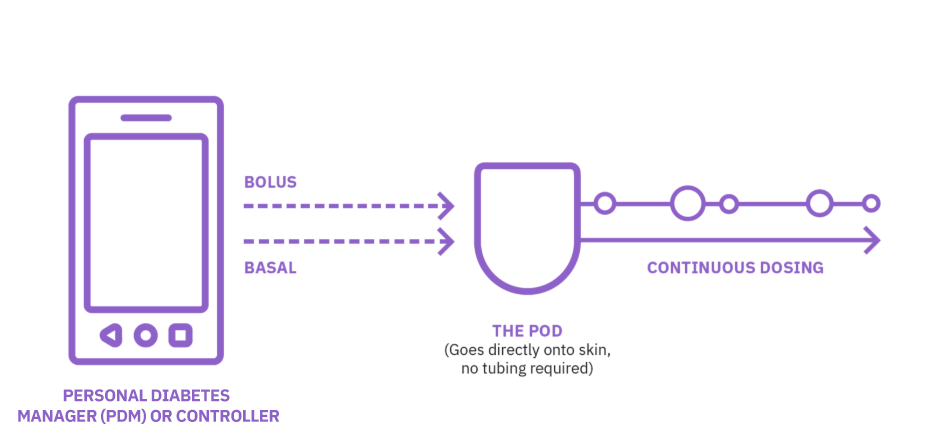
The insulin pump user typically needs to change their infusion set and pump tubing or Pod site every two or three days. Another benefit of a tubeless insulin pump is not having to deal with the inconveniences and challenges of the long tubing becoming snagged or tangled, which can pull out the infusion set.
Insulin pumps have been available for four decades.1,4 Through the years insulin pumps have gotten much smaller and easier to use. In addition, new features have been added to make insulin delivery easier and more convenient as well as features that can potentially reduce hypoglycemia (low glucose levels) and hyperglycemia (high glucose levels). Such as the ability to consider active insulin from a previous bolus also called ‘insulin on board’.
Insulin pumps give more precise insulin doses compared to MDI such as bolus and basal increments as low as 0.025u. Over the last several years, as continuous glucose monitoring (CGM) has become more available to people with diabetes, several insulin pumps can integrate and provide CGM data to the user and their healthcare provider for more precise and easier management.
Are there additional benefits of insulin pump therapy for a person with type 2 diabetes?
Yes, here are some additional benefits below:2, 3

Most pumps have an integrated bolus calculator, making it easier to determine how much bolus insulin to take to cover food (meals, snacks) and to account for high or low glucose levels.

Greater personalization upon which to base optimal bolus doses. The individual insulin to carbohydrate ratio, insulin correction factor, duration of insulin action, and more, are preset with a healthcare provider’s guidance. (These can be changed as needed.)

Fewer incidences of hypogylcemia (low blood glucose).5

Set reminders and alerts to take your bolus insulin doses, check your glucose level and change your infusion site or your Pod.

Access by the user and their healthcare providers to all of the insulin pump data and reports.

Ability to take larger doses of basal or bolus insulin based on individual needs.

Fewer diabetes care supplies to carry because the user is wearing their insulin. However, it is always recommended to carry backup supplies.
Is insulin pump therapy right for me?
Choosing to start insulin pump therapy to manage your or a loved one’s type 2 diabetes is a decision that should be made in concert with a diabetes healthcare provider. Insulin pump therapy may be a good option for a person with type 2 diabetes if you:7,8
- need and want an easier way to deliver insulin
- have an unpredictable schedule that may result in varied insulin needs
- need large amounts of basal and/or bolus insulin
- have higher and lower basal insulin needs during the day
- travel across time zones or do shift work
- participate in athletics or exercise
- want to give insulin discreetly
Is an insulin pump and the supplies typically a covered benefit by healthcare plans?
If you or a loved one with type 2 diabetes have private health insurance, insulin pump therapy will typically be covered. Some people with other forms of state and federal government health coverage (Medicaid and Medicare) may cover insulin pump therapy. The tubeless pump (Omnipod®) may also be available through a pharmacy or Medicare Part D plan. The best way to learn about whether the health plan will cover the insulin pump you want, is to contact the insulin pump company. Their staff will help you determine your insulin pump coverage.
Learn More About the Benefits of Insulin Pump Therapy
Learn more by reading real life stories from people wearing pump therapy systems. Discover how insulin pump therapy is making a world of difference in their lives.

Related Articles



Other topics
References and Disclaimers
1: Cefalu WT, Dawes DE, Gavlak G, et al. Insulin accesss and affordability working group: Conclusions and recommendations. Diabetes Care. 2018;41(6):1299-1311.
2: https://pubmed.ncbi.nlm.nih.gov/37067668/
3: American Diabetes Association Professional Practice Committee. 7. Diabetes technology: Standards of Care in Diabetes—2025. Diabetes Care 2025;48(Suppl. 1):S146–S166
4: American Diabetes Association Professional Practice Committee. 6. Glycemic goals and hypoglycemia: Standards of Care in Diabetes—2025. Diabetes Care 2025;48(Suppl. 1):S128–S145
5: Anders L. Carlson, Lauren M. Huyett, Jay Jantz, Albert Chang, Todd Vienneau, Trang T. Ly, Improved glycemic control in 3,592 adults with type 2 diabetes mellitus initiating a tubeless insulin management system. Diabetes Research and Clinical Practice; 2021; 174, 108735.
6: Aronson R, Reznik Y, Conget I, et al.; OpT2mise Study Group. Sustained efficacy of insulin pump therapy compared with multiple daily injections in type 2 diabetes: 12-month data from the OpT2mise randomized trial. Diabetes Obes Metab 2016;18:500–507
7: Walsh J, Roberts R. Pumping insulin, 5th ed.Torrey Pines Press. 2012.
8: Sikes KA, Weyman K. Diabetes and the use of insulin pumps. Endocrin Advisor. https://www.endocrinologyadvisor.com/home/decision-support-in-medicine/endocrinology-metabolism/diabetes-and-the-use-of-insulin-pumps/. Accessed March 3, 2021.
These modules are not a replacement for medical advice or training. Please always speak to a qualified healthcare professional about your options.
The information and other content provided in this article, or in any linked materials, are not intended and should not be construed as medical advice, nor is the information a substitute for professional medical expertise or treatment. If you or any other person has a medical question or concern, you should consult with your healthcare provider. Never disregard professional medical advice or delay in seeking it because of something that have read on this blog or in any linked materials. If you think you may have a medical emergency, call your doctor or emergency services immediately. The opinions and views expressed on this blog and website have no relation to those of any academic, hospital, health practice or other institution.