The Omnipod® 5 algorithm
How does the Omnipod 5 algorithm work?
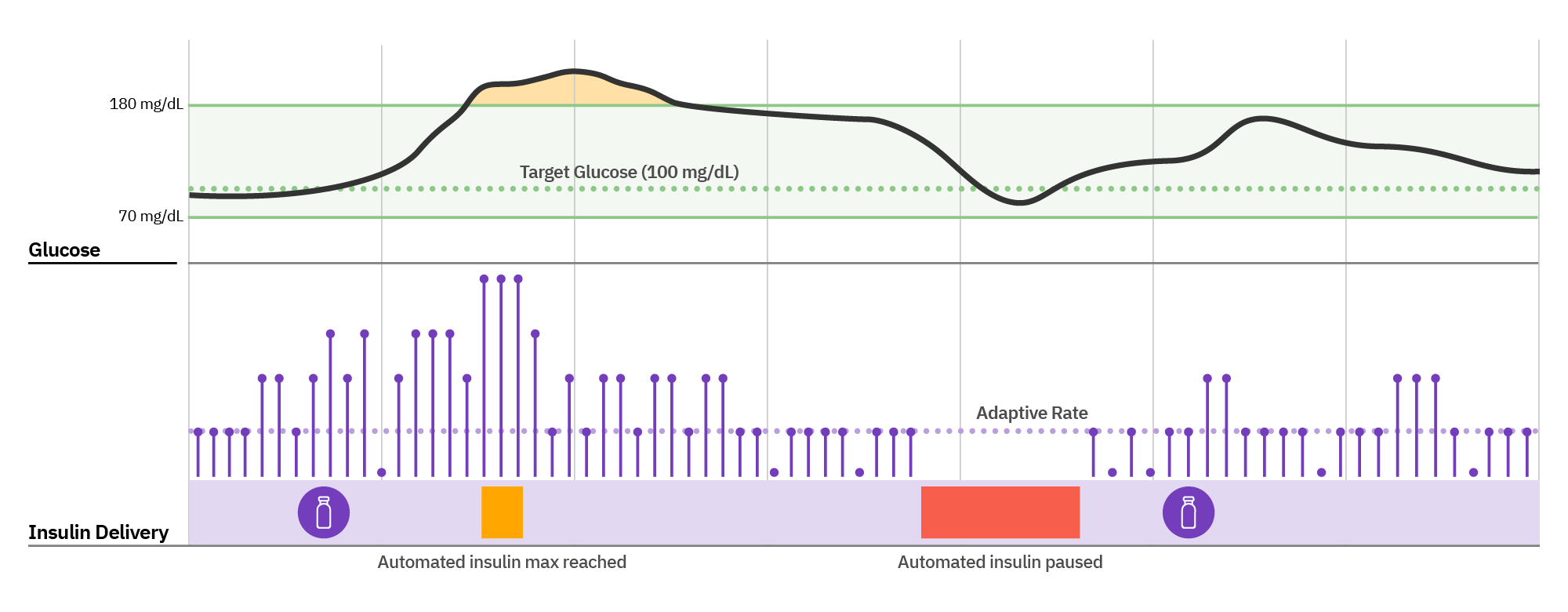
The Omnipod 5 algorithm adjusts insulin delivery every 5 minutes to help proactively correct highs and protect from lows1-3. When the system predicts rises in glucose levels, it proactively adjusts insulin delivery, up to 12 times per hour (and up to 4x a patient’s Adaptive Rate) to minimize time in hyperglycemia. When glucose is trending down, Omnipod 5 can also proactively decrease or pause insulin delivery to help protect against hypoglycemia.
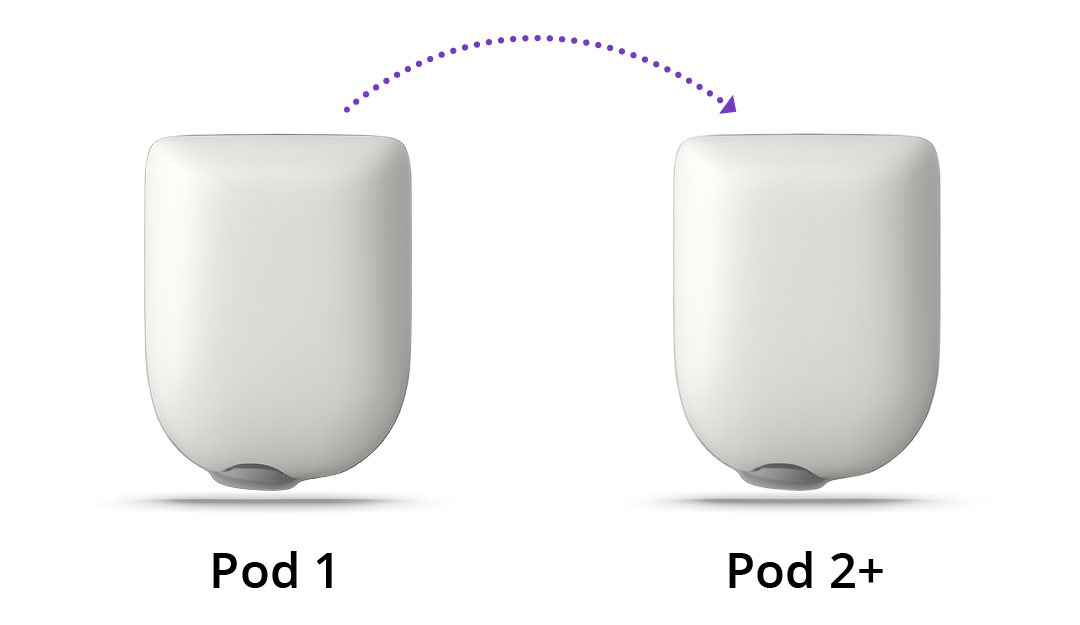
With each Pod change, Omnipod 5 further personalizes care by calculating a new Adaptive Rate based on the patient’s
evolving total daily insulin (TDI) requirements.
CORRECTS
Automated insulin delivery adjustments, every 5 minutes (up to 4x a patient’s Adaptive Rate) to help correct for highs.
HELPS PROTECT
Reduces or pauses insulin delivery if hypoglycemia is experienced or predicted to help protect against lows.
ADAPTS
Adapts to patient’s insulin needs over time and calculates Adaptive Rate (based on TDI) with every Pod change.*
Pods shown without the necessary adhesive.
A Total Daily Insulin (TDI)-based algorithm
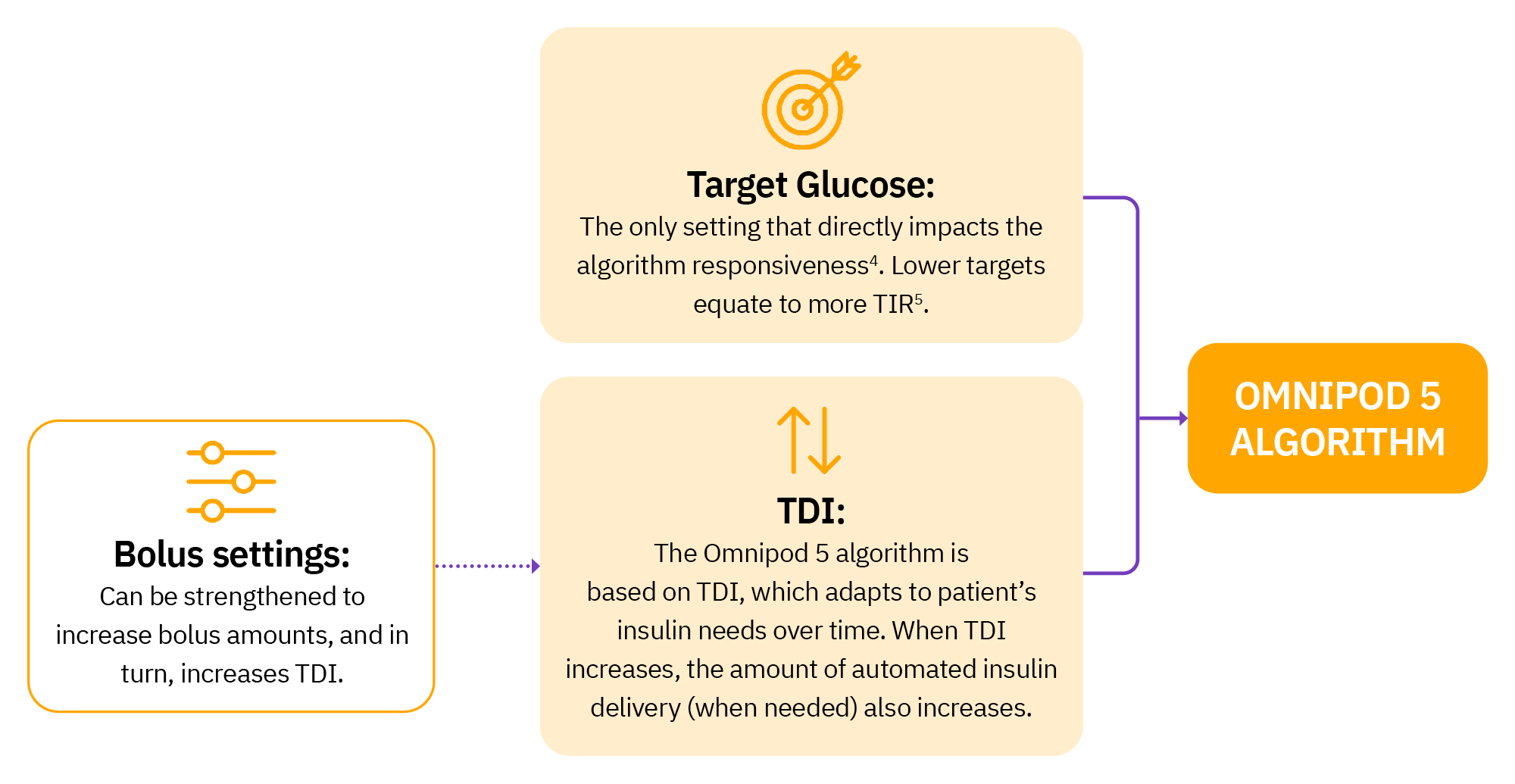
The Omnipod 5 algorithm is driven primarily by total daily insulin (TDI), which reflects a person’s overall insulin needs – both automated delivery and bolus insulin delivery.
With each Pod change, the algorithm utilizes the updated TDI, based on the user’s actual insulin delivered. Over time, the algorithm can adapt to longer term changes in insulin needs, such as weight changes, puberty, growth, and aging. An increase in TDI informs the system that insulin needs are increasing and allows the system to deliver more insulin.
Adaptive Rate
- The Omnipod 5 algorithm assumes that ~50% of a user’s TDI represents basal insulin needs, known as the Adaptive Rate. This baseline amount of insulin is delivered through automated insulin delivery, in Automated Mode. The remaining ~50% of TDI is intended to be delivered as user-initiated bolus (insulin for meals, snacks, and corrections).
- Because the Adaptive Rate accounts for only about 50% of TDI, bolus insulin plays a critical role. Regular bolusing for meals, snacks, and corrections—and appropriately strong bolus settings—helps ensure that the TDI used by the system accurately reflects this 50/50 basal–bolus balance.
- Inconsistent bolusing for meals and snacks can lead the system to underestimate TDI, which may result in an Adaptive Rate that does not fully reflect the user’s true basal insulin requirements. In instances where insulin needs are underestimated, and hyperglycemia occurs, Omnipod 5 will adjust insulin delivery, up to 12 times per hour (and up to 4x a patient’s Adaptive Rate) to minimize time in hyperglycemia and hypoglycemia1-3.
Understanding an Omnipod 5 user’s total daily insulin and Adaptive Rate in real life
Meet John†, a 34-year-old with type 1 diabetes using the Omnipod 5 system. John’s baseline insulin needs are 50 units per day TDI (total daily insulin).
Based on the Omnipod 5 algorithm:
- ~25 units/day are expected to be delivered through automated insulin
delivery to cover his background insulin needs - ~25 units/day are expected to be delivered as user-initiated boluses for
meals, snacks, and/or corrections
Scenario 1: John consistently boluses for meals and snacks
Scenario 2: John inconsistently boluses for meals and snacks
Setting your patients up for success
Not all insulin delivery is the same between AID systems or multiple daily injections (MDI). It’s important to review and re-evaluate a patient’s insulin needs prior to changing therapy so that when starting Omnipod 5 the patient’s initial settings reflect current insulin needs. For stronger glycemic results, start with strong settings4-5:
| INITIAL SETTING CONSIDERATIONS4-5 | |
|---|---|
| Target Glucose | Using the lowest Target Glucose enables more responsive insulin delivery and may lead to more time in range |
| Bolus settings | Stronger bolus settings may increase TDI. When TDI increases, the amount of automated insulin delivery (when needed) also increases |
| Total daily insulin (TDI) | Program basal rates to represent ~50% TDI to help the system estimate TDI most effectively TIP: For users transitioning to Omnipod 5, using historical insulin delivery to estimate TDI can provide a more accurate reflection of real-world insulin use than prescribed doses alone. |
Use Insulet’s Pump Therapy Order Form (PTOF) to help set your patients up for success from the start.
How Omnipod 5 adapts over time

Initial use
With no insulin history, Omnipod 5 estimates TDI using the programmed basal rates entered during first-time setup.
- Omnipod 5 will calculate an initial Adaptive Rate based on the estimated TDI
- Since the algorithm has no history, the first Pod is more conservative, and the maximum amount of insulin delivered is restrained
- After initiation, changing programmed basal rates or basal setting constraints (ex. Max Basal) have no impact on the algorithm
Ongoing use
The algorithm adapts to patients’ changing insulin needs.
- After the first Pod change, the algorithm updates TDI, from actual insulin history to calculate the new Adaptive Rate
- At this point, automated max delivery is no longer constrained and can increase up to 4x when needed*
Pods shown without the necessary adhesive.
Optimization: the settings you can change to increase algorithm responsiveness
Initial settings may be more conservative to align with consensus recommendations and support successful therapy initiation. At follow-up visits, settings should be reviewed and adjusted as appropriate to help optimize time in range4-5.
Real world evidence (RWE) showed over 80% time in range with optimized settings6
| RWE informed settings to help maximize time in range6 | |
|---|---|
| SETTING | OPTIMIZED VALUE |
| Target Glucose | 110 mg/dL |
| Insulin to Carb Ratio | ≤350/TDI |
| Correction Factor | ≤1500/TDI |
Now with a lower 100 mg/dL Target Glucose for more time in range with no meaningful impact on time below range7!
Frequently asked questions:
What are the latest enhancements to the Omnipod 5 algorithm?
What drives the Omnipod 5 algorithm?
How often can the system adjust insulin?
Which setting most directly affects the algorithm’s responsiveness?
† John is not a real person. This fictional case study is not related to the image shown.
1. Brown S. et al. Diabetes Care. 2021;44:1630-1640. Prospective pivotal trial in 240 participants with T1D aged 6 - 70 yrs [adults/adolescents (n= 128; aged 14-70 yrs) children (n=112; aged 6-13.9 yrs)]. Study included a 14-day standard therapy (ST) phase followed by a 3-month Omnipod 5 hybrid closed-loop phase. Mean time >180 mg/dL in adults/adolescents and children, ST vs. 3-mo Omnipod 5: 32.4% vs. 24.7%; 45.3% vs. 30.2%, P<0.0001, respectively. Mean time <70 mg/dL in adults/adolescents and children, ST vs. 3-mo Omnipod 5: 2.9% vs. 1.3%, P<0.0001; 2.2% vs. 1.8%, P=0.8153, respectively. Results measured by CGM. Study funded by Insulet.
2. Sherr JL, et al. Diabetes Care. 2022. 45(8):1907–1910. Prospective trial in 80 participants with T1D aged 2 - 5.9 yrs. Study included a 14-day standard therapy (ST) phase followed by a 3-month Omnipod 5 hybrid closed-loop (HCL) phase. Mean time >180 mg/dL in very young children (2 - 5.9yrs) as measured by CGM: ST = 39.4%, 3-mo Omnipod 5 = 29.5%, P<0.0001. Mean time <70 mg/dL in very young children (2-5.9 yrs) as measured by CGM: ST = 3.43%, 3-mo Omnipod 5 = 2.46%, P=0.0204. Results measured by CGM. Study funded by Insulet.
3. Pasquel FJ, et al. JAMA Network Open (2025). Prospective pivotal trial in 305 participants with T2D aged 18-75 yrs. Study included a 14-day standard therapy (ST) phase followed by a 13- week Omnipod 5 hybrid closed-loop phase. Mean time >180 mg/dL as measured by CGM: ST = 54%, 3-mo Omnipod 5 = 34%, P<0.001. Mean time <70 mg/dL as measured by CGM: ST = 0.2%, 3-mo Omnipod 5 = 0.2%.
4. Berget C, Annan SF, Biester T, etal. Diabetes Obes Metab. 2025;1-11.
5. Berget C, et al. Clinical Diabetes. 2022;40(2):168-184.
6. Sawyer A, et al. Diabetes Technol Ther. 2026 (T1D). Data on file. 2026. RF-062026-00044 (T2D). Retrospective RWE of U.S. T1D and T2D users utilizing optimized settings including sufficient CGM data (≥75% of days with ≥220 readings), ≥90% time in Automated Mode, and ≥5 bolus/day (T1D) or ≥3 bolus/day (T2D). Optimized settings: CF x TDI ≤1500, I:C Ratio x TDI ≤350, Average Target Glucose of 110-115 mg/dL.
7. In a simulated analysis, the 100 mg/dL Target Glucose (TG) setting demonstrated superior Time in Range (70-180 mg/dL) and non-inferior Time Below Range (<70 mg/dL) compared with results at the 110-150 mg/dL TG settings in a real-world population of people with T1D using Omnipod 5. Differences in mean TIR for 100mg/dL vs 110mg/dL, vs 120 mg/dL, vs 130 mg/dL, vs 140 mg/dL, vs 150 mg/dL were 2.5%, 4.8%, 9.8%, 15.3%, and 20.8%, respectively. For each comparison, the lower bound of the one-sided 95% Confidence Interval (CI) was > 0, meeting the pre-specified superiority criterion. Differences in mean TBR for 100mg/dL vs 110mg/dL, vs 120 mg/dL, vs 130 mg/dL, vs 140 mg/dL, vs 150 mg/dL were 0.4%, 0.7%, 0.8%, 0.9%, and 0.9%, respectively. For each comparison, the upper bound of the one-sided 95% Confidence Interval (CI) was below the 2% non inferiority margin. Analysis not controlled for ISF, ICR, % time in Automated Mode and number of bolus/day. Data on File. RF-012026-00057.
The Omnipod 5 Automated Insulin Delivery System is indicated for use by individuals with type 1 diabetes mellitus in persons 2 years of age and older and type 2 diabetes mellitus in persons 18 years of age and older. The Omnipod 5 System is intended for single patient, home use and requires a prescription. The Omnipod 5 System is compatible with the following U-100 insulins: NovoLog®, Humalog®, Admelog® and Kirsty®.
Refer to the Omnipod® 5 Automated Insulin Delivery System User Guide and www.omnipod.com/safety for complete safety information including indications, contraindications, warnings, cautions, and instructions. Warning: DO NOT start to use the Omnipod 5 System or change settings without adequate training and guidance from a healthcare provider. Initiating and adjusting settings incorrectly can result in over-delivery or under-delivery of insulin, which could lead to hypoglycemia or hyperglycemia. Warning: Do not use SmartAdjust technology in persons under 2 years of age or who use less than 5U of insulin per day.
Available products subject to current insurance coverage and product indication for use. Insulet can only support onboarding for those customers within the product indication.
INS-OHS-04-2026-00046 V2.0