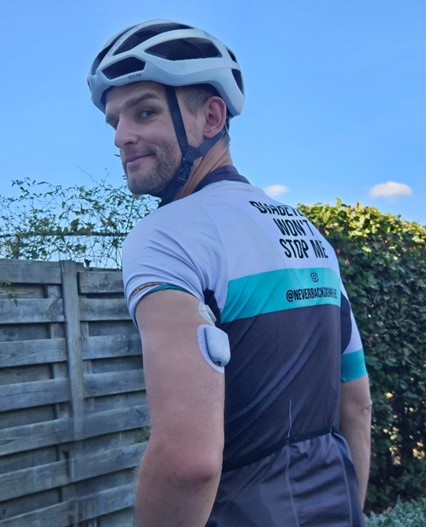
As a child I enjoyed taking on challenges. I remember that I assigned myself the task of learning the capital of every country in the world by heart in primary school, or inventing and creating entirely new board games because I got bored of the ones I had at home.
I was never in doubt that I could succeed in the endeavours if I just applied myself enough.
This confidence was shaken when I was diagnosed with type 1 diabetes at the age of 13. Suddenly I was overwhelmed by a chronic condition that seemed completely out of my control. I had to accept that even if I put all my efforts into preparing a presentation at school or was doing my absolute best for an important test, a hypo or hyper could still throw a spanner in the works.
I was also an active child.
I loved being outdoors and spent most of the weekends and summers playing in the forests around our family home. After my diagnosis, I remember the doctors warning me about exercise. They said I shouldn’t overdo it with diabetes, and I had to avoid hypos at all costs. So, I often ended up sitting on the sidelines during gym class, either because I didn’t feel too great or because I just didn’t like the sport they were practising that day.
I even started to use my diabetes as an excuse to get out of physical activity.
As a result, I always ended up getting picked last in football team selection and started to accept that I simply wasn’t and would never be any good at sports.
Building Confidence
But times have changed.
In my 30s I finally found the motivation to start exercising again. I managed to regain confidence in the management of my diabetes with the help of new diabetes technology, such as a CGM and the Omnipod DASH® system. I also found strong support in my diabetes team at the hospital, where the view on diabetes and exercise had evolved quite a bit over time.
A few weeks ago, I took part in the UCI Gravel World Championships in Belgium, after having qualified in Italy last spring. It was a grueling 110-mile grace mostly on offroad forest paths, including some scary muddy single tracks, rough cobbles and a never-ending succession of rolling hills, but I enjoyed every second of it.
It had been a long-time dream to qualify and compete with the world’s best gravel riders, and a crowning achievement after 8 years of hard work.
Even now that I’ve completed the race successfully and have a medal displayed in my office as proof, I still find it hard to accept that I really deserve it.
In fact, this is a feeling that always seems to be at the back of my mind while racing.
When I see the other participants lining up for the start, I suddenly feel unfit and out of place, like I just sneaked in through the back door, and don’t really belong there. I look around and see all these people that I assume are so much fitter and stronger than me.
I start thinking ‘what on earth am I doing here?’, and my mind starts telling me that I’m not an athlete, I’m just pretending to be one and was lucky enough to talk my way into this race.
The Power of Self-determination
This imposter syndrome also hit me at the qualifier race in Sardinia, Italy, in April.
At first, I moved forward through the peloton when the race started. When we hit the mountains, I rode out with a small group for the first lap but lost them when I stopped at an aid station to take a bottle of water. After that I was riding alone for most of the 5 hours of the race.
When I passed the finish line, I felt awful, because I thought I’d finished dead last. My glucose level was trending low, so that may have clouded my judgement as my mind was racing with thoughts about quitting cycling altogether, since it was obvious that I was a complete failure.
However, when I got back to the hotel and decided to finally check the results, it turned out I’d finished 3rd, and I had to hurry back to the race venue for the podium ceremony. This unexpected turn of events really turned my mood around, making the whole thing an unforgettable experience.
But back home the doubts returned.
Maybe the field at the race had been unusually weak? Maybe I’d just been lucky because a few other strong participants had a mechanical on the course? Even now that I’m at peak fitness and have a sports track record to be proud of, I still must fight these thoughts every time I race.
If you’ve been diagnosed with type 1 diabetes, please don’t let it discourage you from taking on challenges and living your best life. But remember it’s more than a medical condition we must learn to manage. It also affects our mind and mental health, even when we seem to be in full control.