Supporting NHS delivery of NICE Hybrid Closed Loop (HCL) access
Insulet is committed to working with health service commissioners and planners to make Automated Insulin Delivery (AID) technology standard of care for people with type 1 diabetes. Our market access team supports you through every step of implementing the landmark NICE HCL guidance (TA943). We can help plan and navigate funding, ease service pressures and map out how implementation can be planned, prioritised and advanced.
Understanding the NICE hybrid closed loop guidance (TA943): Access & funding for people with type 1 diabetes
In December 2023, NICE published landmark guidance on HCL systems. This is a significant milestone on the journey towards making AID/HCL technology standard of care, transforming the lives of people living with type 1 diabetes.
NICE eligibility criteria
The NICE Hybrid Closed Loop guidance (TA943) recommends HCL technology for three key groups:
1. Adults with type 1 diabetes who fall into the highest‑need group (roughly 60% of the adult T1D population according to the National Diabetes Audit), defined specifically as those who:
- Have an HbA1c of 58 mmol/mol (7.5%) or higher, or
- Experience disabling hypoglycaemia despite best possible management with CSII, rtCGM or isCGM;
2. Children and young people with type 1 diabetes;
3. People with type 1 diabetes who are pregnant or planning a pregnancy*
How NICE HCL guidance is implemented across the NHS in England

Unlike most technology appraisals, TA943 is being implemented through a five‑year NHS England plan with dedicated or ring-fenced funding. The programme began in April 2024.
The five-year plan sets a clear national direction. Delivering access at scale requires careful planning, realistic modelling, and tailored support.
A national implementation programme for HCL technology is also being rolled out in Scotland with similar dedicated funding. Our market access team is also able to provide support with implementation in Scotland and in Wales.
Funding for TA943: planned funding and how to access it
The NHS England plan directs dedicated financial support for implementing the NICE HCL guidance. 75% of this comes from NHS England itself and the remaining 25% must be provided by integrated care boards (ICBs) from their overall resources.
The NHS England funding support for the remaining years of the five-year plan has been set out as follows:
- £107.3 million for 2026–2027
- £120 million for 2027–2028
- £120 million for 2028–2029
When the 25% ICB contribution is added in, this unlocks £434 million in ring‑fenced investment for HCL technology between now and March 2029. Substantial as this is, significant amounts of additional local investment will be required in order to implement fully the NICE guidance for all who want HCL and who are eligible.
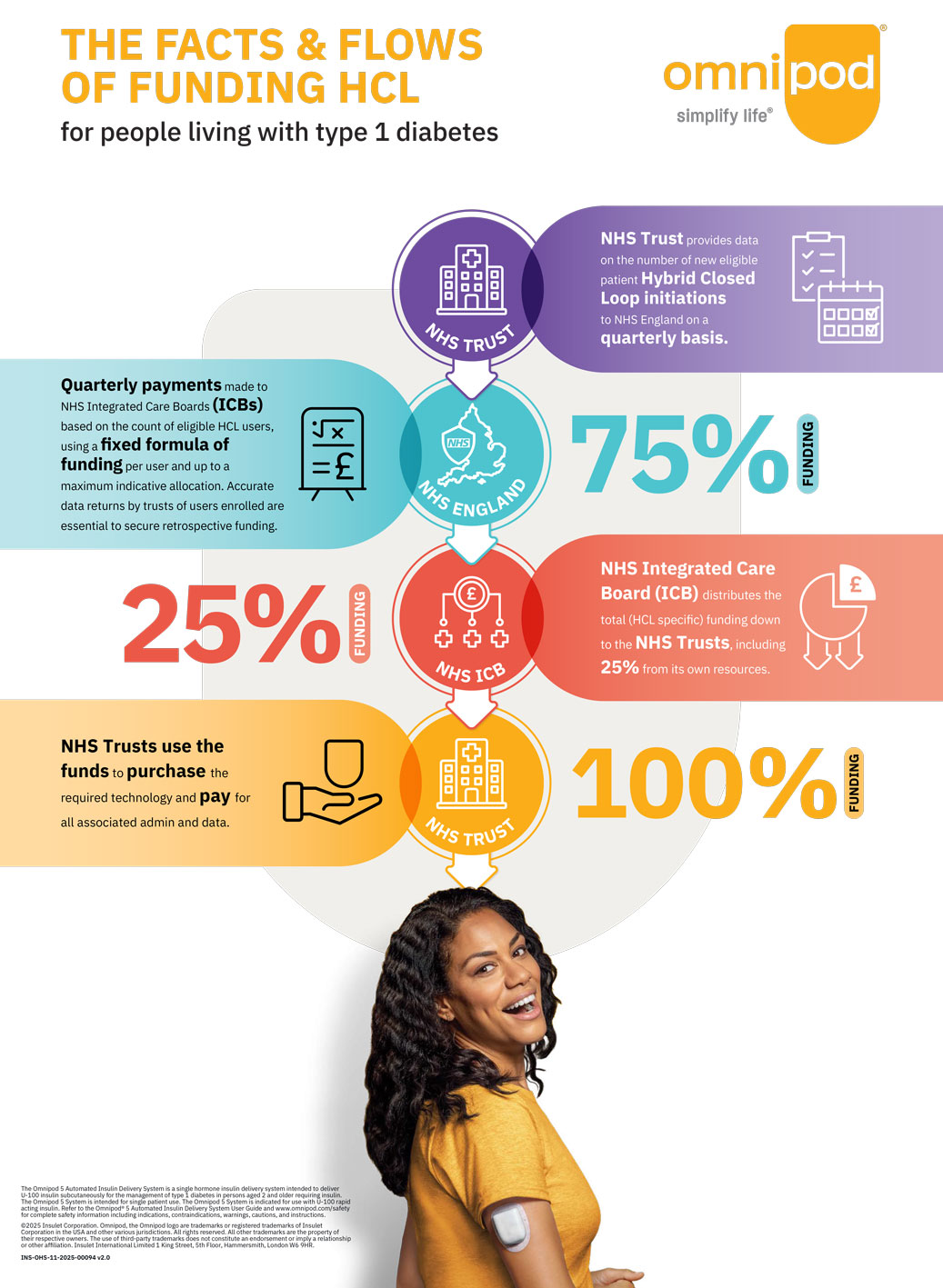
At a local level, teams should:
- Use all the ring‑fenced funding, ensuring it flows from ICBs to trusts and ultimately reaches people with type 1 diabetes
- Plan a phased rollout, prioritizing those with highest need and addressing inequalities.
- Procure via NHS Supply Chain to ensure HCL technology remains cost‑effective.
- Monitor and report uptake and outcomes to support future allocations.
- Consider where savings might be made from elsewhere in diabetes or other programmes in order to invest in the full potential of HCL
Our team can guide you through the process step by step, providing the evidence and models needed for confident decision-making.
From paediatric to adult HCL uptake
Over the last decade, technology has dramatically improved outcomes for children and young people with type 1 diabetes, and with more than 70% now using hybrid closed loop systems. The resulting benefits to the NHS and to young lives have been profound.
The focus of the five-year plan is now shifting to adults, where the challenges are considerably greater.
- There are around ten times more adults than children and young people living with type 1 diabetes.
- Adult services are typically more stretched and under-resourced.
NHS England estimates that the planned funding for HCL is sufficient to bring 30% of eligible adults onto HCL. This equates to fewer than one in five adults with T1D overall, highlighting the scale of the funding challenge to be addressed.
Learn how Insulet supported an ICB to evaluate real budget impact and uphold patient choice during HCL rollout, delivering clearer planning and more sustainable decision-making.
What the experts say…
Progress towards implementing the NICE HCL guidance and the challenges that lie ahead were reviewed by an expert panel during a policy roundtable discussion in December 2025 run by the Health Service Journal and sponsored by Insulet.
Budgeting considerations

1) HCL isn’t the only budget line.
Insulin pump therapy for T1D have been NICE mandated since 2008*; associated costs should already be reflected in local budgets and capacity.

2) Lower upfront costs with Omnipod® 5.
With a pay‑as‑you‑use model, there is no upfront pump cost. This is particularly helpful for systems facing short‑term constraints and for phased adult scale-up.

3) Supply Chain pricing matters.
HCL components are supplied at lower cost via the NHS Supply Chain framework than published list prices. Using HCL‑negotiated prices may create headroom vs. previous plans.

4) Demonstrated cost-effectiveness
NHS England/Supply Chain has confirmed Omnipod® 5 as cost‑effective when used with Dexcom G6, Dexcom G7 or FreeStyle Libre 2 Plus. Our four‑year budget impact models show how costs and benefits compare with other insulin delivery approaches*.

How we can support NHS teams
We help commissioners plan, fund and implement HCL at scale through:
- Budget impact & forecasting: Localised modelling that shows how far your resources stretch and what’s needed to cover all eligible adults.
- Implementation practicalities: Guides and tools designed to reduce operational friction.
- Capacity & workforce planning: A realistic adult roll‑out plan aligned to your clinic capacity, workforce and onboarding pace.
- Evidence pack for ICB approvals: A commissioner‑ready business case pack with financials, delivery plan and TA943‑aligned reporting requirements.
- Peer support connections: Direct links to NHS teams already delivering at scale.
- HCL calculators & forecasting tools: Digital tools to monitor uptake, activity and spend.
FAQs
What is the status of implementing TA 943?
Will the available funding be sufficient to implement the NICE TA 943 in full?
What does the five-year plan state about how implementation should be prioritized?