RADIANT RCT: Switching from MDI to Omnipod® 5

Gave People With T1D More Than Five Extra Hours In Range Per Day

A direct switch from MDI to the Omnipod 5 AID (automated insulin delivery; hybrid closed-loop) System produced clinically significant glucose improvements within 13 weeks, signalling a practical leap forward in improved diabetes care for children and adults alike.2

MDI remains the default therapy for many people with T1D and many still fail to meet glycaemic targets despite CGM (continuous glucose monitor) use. The multinational RADIANT trial is the first randomized controlled trial comparing MDI therapy to a tubeless AID system; an important proof-point for clinicians seeking new treatment options for their patients living with T1D.1
 

The findings carry particular weight considering, globally, an increasing number of guidelines and consensus statements recognise the value of AID technology for facilitating the attainment of glycaemic targets in people with T1D.3,4

Study Design1,2

Design: 13-week, randomised (2:1), multicentre study in the UK, France, and Belgium

Participants: 188 children and adults (4–70 years) with T1D on MDI + CGM, baseline mean HbA1c 8.3%

Treatment group: Start tubeless insulin pump therapy with Omnipod 5 + CGM (N=125)

MDI group: Continue MDI + CGM (N=63) 
 

Study Results2

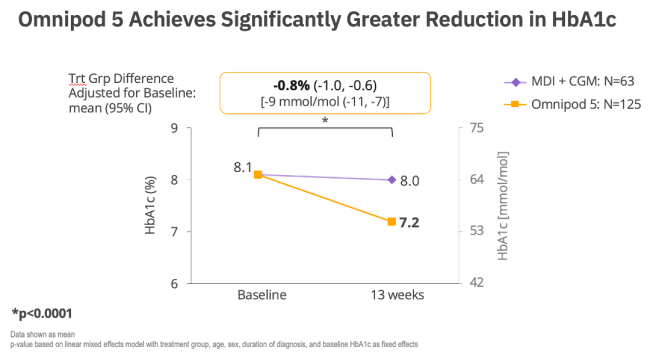
Mean change in HbA1c

Image
rct graph graphic omnipod 5

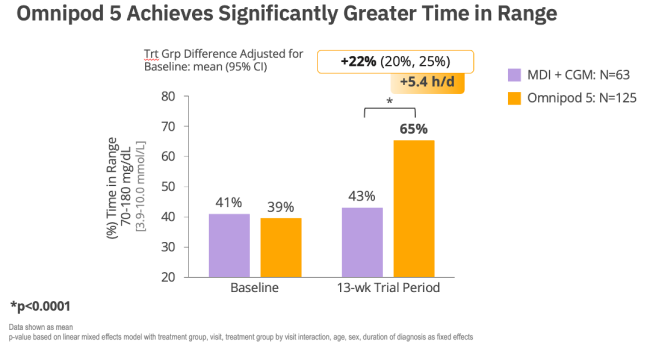
Mean change in TIR (3.9-10 mmol/L [70-180 mg/dL])2
 

Image
rct graph graphic 2 omnipod 5

Safety Profile2

During the 13-week study, time spent with glucose below 3.9 mmol/L (70 mg/dL) changed from 2.24% to 2.56% in the Omnipod group and from 1.16% to 2.27% in the MDI group. The difference satisfied the trial’s non-inferiority criterion, indicating comparable protection against hypoglycaemia.  

Furthermore, participants using Omnipod 5 spent significantly less time above range compared to the MDI group, reducing high (>10 mmol/L [>180 mg/dL]) and very-high (>16.7 mmol/L [>300 mg/dL]) glucose exposure by roughly 22% and 8.5%, respectively.

No episodes of severe hypoglycaemia or diabetic ketoacidosis occurred in either group. 

Translating the Data into Everyday Practice

The RADIANT trial showed that people on MDI therapy can adopt a diabetes management technology that is automated, on-body, and algorithm-driven. Users experienced robust gains in glycaemic control with no extra burden of hypoglycaemia; underscoring the clinical benefits of Omnipod 5 for real-world clinics focused on outcome-driven, long-term diabetes care strategies.
 

Ready to explore all the data?

See additional clinical and quality-of-life studies on Omnipod 5 in children, adolescents and adults here

Prescribing Made Simple

Everything you need to initiate Omnipod 5 is outlined here, from prescription details to patient support resources.

Clinical FAQs

What were the primary findings of the RADIANT trial?

Were there any safety concerns such as hypoglycaemia or DKA?

What are the key takeaways for clinical practice?

What is the approved age range for Omnipod 5 use?

How does the SmartAdjust™ algorithm support hypoglycaemia prevention?

HbA1c = glycated haemoglobin; HCL = hybrid closed loop; MDI = multiple daily injections; NICE = National Institute for Health and Care Excellence; RCT = randomised controlled trial; T1D = type 1 diabetes; TIR = time in range.

The Omnipod 5 Automated Insulin Delivery System is a single hormone insulin delivery system intended to deliver U-100 insulin subcutaneously for the management of type 1 diabetes in persons aged 2 and older requiring insulin. The Omnipod 5 System is intended for single patient use. The Omnipod 5 System is indicated for use with NovoLog®/NovoRapid®, Humalog®, Trurapi®/Truvelog®/Insulin aspart Sanofi®, Kirsty®, and Admelog/Insulin lispro Sanofi U-100 insulin. Refer to the Omnipod® 5 Automated Insulin Delivery System User Guide and www.omnipod.com/safety for complete safety information including indications, contraindications, warnings, cautions, and instructions.

1.  Insulet’s RADIANT Trial Demonstrates Meaningful Glycemic Improvements with the Omnipod® 5 Automated Insulin Delivery System Following Direct Transition from Multiple Daily Injections. March 19, 2025. Accessed June 4, 2025. https://investors.insulet.com/news/news-details/2025/Insulets-RADIANT-Trial-Demonstrates-Meaningful-Glycemic-Improvements-with-the-Omnipod-5-Automated-Insulin-Delivery-System-Following-Direct-Transition-from-Multiple-Daily-Injections/default.aspx 

2. RADIANT Trial. Data on File. 2025. RF-042025-00015. 

3. Holt R, et al. The management of type 1 diabetes in adults. A consensus report by the American Diabetes Association (ADA) and the European Association for the Study of Diabetes (EASD). Diabetologia. 2021;64(12):2609-2652 

4. Moshe Philip, et al. Consensus recommendations for the use of Automated Insulin Delivery (AID) technologies in clinical practice, Endocr Rev. 2023;4;44(2):254-280.