Omnipod® 5 and Dexcom: powerful partners for diabetes management
Say goodbye to multiple daily injections, insulin pump tubing and finger prick testing with the Omnipod® 5 Automated Insulin Delivery System, paired seamlessly with the latest Dexcom technology.
Helping you to stay in range, day and night1,2
Omnipod 5 is the only wearable, tubeless, automated insulin delivery (AID) system that works with the Dexcom G7 continuous glucose monitor (CGM) sensors. AID systems are also known as hybrid closed loop systems.
Using our algorithm technology, Omnipod 5 and your Dexcom sensor are in constant communication, smoothly responding to predicted glucose levels by automatically adjusting insulin delivery every five minutes.
Omnipod 5 has been shown to increase time in range and decrease HbA1c, while helping to protect against highs and lows, day and night1,2
Share the load with a system that’s always adjusting*, so you don’t have to.

Simplify Life® with Omnipod 5
Experience the freedom and simplicity of automated insulin delivery with Omnipod 5.
Each tubeless, waterproof‡ Pod is worn for up to three days (72 hours), worn with a compatible sensor to adjust insulin delivery every five minutes.
The handheld, wireless Controller allows you to deliver bolus insulin for meals and correction doses quickly and discreetly.
The result? Less time focused on diabetes. More time focused on life.
Continuous glucose monitoring made easy with Dexcom
Dexcom is a pioneer in real-time continuous glucose monitoring.
For more than 20 years, Dexcom has been dedicated to developing simpler and better ways for people with diabetes to measure, track and manage their glucose.
How does Dexcom work?
Dexcom gives you glucose readings in real time, helping you to make informed diabetes treatment decisions without finger prick testing§!
- Your choice of Dexcom sensor is inserted just under the skin
- Glucose readings are wirelessly and automatically sent to your compatible smart device† or Controller every five minutes, without the need for scanning
- Trend arrows show where your numbers are heading and how fast
- Customisable high and low alerts tell you when your glucose is heading out of range
- Spread the peace of mind and share your glucose data with caregivers and loved ones using Dexcom Follow
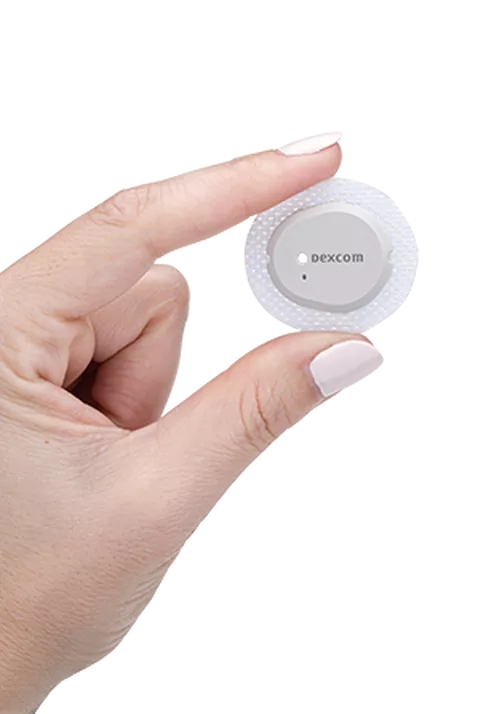
- The Dexcom G7 is Dexcom’s smallest sensor to date. When used with Omnipod 5, the shorter 30 minute warmup time gives you more time in Automated Mode§.
How does an Automated Insulin Delivery (AID) System work?
- The Dexcom sensor sends your glucose levels to the Omnipod 5 Pod’s built-in algorithm.
- The Omnipod 5 algorithm—which lives directly on the Pod—continuously calculates whether insulin delivery needs to be increased, decreased, paused, or maintained.
- The Pod automatically executes these delivery adjustments every five minutes.
- The Dexcom sensor continuously monitors your glucose response and reports the new data to the algorithm.
- The cycle continues, creating a continuous ‘closed-loop’ system.
- Bolus doses for meals or corrections are programmed by you using the Omnipod 5 Controller, which then sends that command to the Pod.
Here’s what our Podders have to say about Omnipod 5
Omnipod 5 has allowed me to get a good night sleep. That's the first time I can say that in a long time.
Alvin
Podder since 2017
It helps me feel like a normal kid, just with a little bit of help.
Romey T.
Sponsored Podder®
With Omnipod 5, I’ve found a new confidence that I didn’t have before… I feel like a new person. Omnipod 5 makes me feel safe.
Morgan M.
Podder®
Frequently Asked Questions
What is the Omnipod 5 Automated Insulin Delivery System?
How does Omnipod 5 work?
What is Automated Insulin Delivery (AID)?
Is Omnipod 5 a Hybrid Closed Loop system?
Does Omnipod have a continuous glucose monitor (CGM)?
Which CGM works with Omnipod?
Can I use any other Dexcom systems with Omnipod 5?
Does Omnipod 5 work with Dexcom G7?
What distance is needed between the Dexcom CGM sensor and the Omnipod 5 Pod?
Can you wear Omnipod and Dexcom on the same arm?
How do you use an Omnipod? How do you use the Omnipod 5 Controller?
How big is the Pod? What does it feel like to wear?
Looking for more information
Check out our library of resources below to continue learning about Omnipod 5:
*When used in automated mode with Dexcom G7, the Omnipod 5 System makes adjustments to insulin delivery every 5 minutes based on the user's current CGM value, glucose values predicted 60 minutes in the future, glucose trend, and past insulin delivery to bring glucose to a user defined target.
‡The Pod has a waterproof IP28 rating for up to 7.6 metres for up to 60 minutes. The Omnipod® 5 Controller is not waterproof. The Dexcom sensor and transmitter are water-resistant and may be submerged under 2.4 metres (8 feet) of water for up to 24 hours without failure when properly installed.
†For a list of compatible devices,visit www.dexcom.com/compatibility
§ More time in automated mode based on 30 min warm up time for Dexcom G7. During sensor warm up the system enters Automated Mode: Limited.
** The demo Pod is a needle-free Pod that does not deliver insulin. PDM/Controller not included.
1. Brown S. et al. Diabetes Care. 2021;44:1630-1640. Prospective pivotal trial in 240 participants with T1D aged 6 - 70 yrs. Study included a 14-day standard therapy (ST) phase followed by a 3-month Omnipod 5 hybrid closed-loop (HCL) phase. Mean time in range (3.9-10.0 mmol/L or 70-180mg/dL) in adults/adolescents as measured by CGM: ST = 64.7%, 3-mo Omnipod 5 = 73.9%, P<0.0001. Mean time in range (3.9-10.0 mmol/L or 70-180mg/dL) in children as measured by CGM: ST = 52.5%, 3-mo Omnipod 5 = 68.0%, P<0.0001. Mean HbA1c: ST vs. Omnipod 5 use in adults/adolescents (14-70 yrs) and children (6-13.9 yrs), respectively (7.16% vs 6.78% or 55 mmol/mol vs. 51 mmol/mol, P<0.0001; 7.67% vs 6.99% or 60mmol/mol vs 53 mmol/mol), P<0.0001. Mean time >10.0 mmol/L or >180mg/dL (12AM-<6AM) as measured by CGM in adults/adolescents and children ST vs. 3-mo Omnipod 5: 32.1% vs. 20.7%; 42.2% vs 20.7%, P<0.0001, respectively. Mean time >10.0 mmol/L or >180mg/dL (6AM-<12AM) as measured by CGM in adults/adolescents and children ST vs. 3-mo Omnipod 5: 32.6% vs. 26.1%; 46.4% vs 33.4%, P<0.0001, respectively. Mean time <3.9 mmol/L or <70 mg/dL (12AM-<6AM) as measured by CGM in adults/adolescents and children ST vs. 3-mo Omnipod 5: 3.64% vs. 1.17%, P<0.0001; 2.51% vs. 1.78, P=0.0456, respectively. Mean time <3.9 mmol/L or <70 mg/dL (6AM-<12AM) as measured by CGM in adults/adolescents and children ST vs. 3-mo Omnipod 5: 2.64% vs. 1.37%, P<0.0001; 2.13% vs. 1.98%, P=0.2545, respectively.
2. Sherr J. et al. Diabetes Care. 2022; 45:1907-1910. Single-arm multicenter clinical trial in 80 pre-school children (aged 2-5.9 yrs) with T1D. Study included a 14-daystandard therapy (ST) phase followed by a 3-month AID phase with Omnipod 5 system. Mean HbA1c as measured in very young children, ST vs. Omnipod 5 use:7.4% vs 6.9% or 57 mmol/ml vs. 53 mmol/mol; (P<0.0001). Mean time in range (3.9-10.0 mmol/L or 70-180mg/dL) as measured by CGM in children ST vs. 3-mo Omnipod 5: 57.2% vs 68.1%, P<0.0001. Mean time >10.0 mmol/L or >180mg/dL (12AM-<6AM) as measured by CGM in children ST vs. 3-mo Omnipod 5: 38.4% vs. 16.9%, P<0.0001, respectively. Mean time >10.0 mmol/L or >180mg/dL (6AM-<12AM) as measured by CGM in children ST vs. 3-mo Omnipod 5: 39.7% vs. 33.7%, P<0.0001, respectively. Mean time <3.9 mmol/L or <70 mg/dL (12AM-<6AM) as measured by CGM in children ST vs. 3-mo Omnipod 5: 3.41% vs. 2.13%, P=0.0185. Mean time <3.9 mmol/L or <70 mg/dL (6AM-<12AM) as measured by CGM in children ST vs. 3-mo Omnipod 5: 3.44% vs. 2.57%, P=0.0799.
Intended Purpose as per Instructions for Use for The Omnipod 5 Automated Insulin Delivery System:
The Omnipod 5 Automated Insulin Delivery System is a single hormone insulin delivery system intended to deliver U-100 insulin subcutaneously for the management of type 1 diabetes in persons aged 2 and older requiring insulin. The Omnipod 5 System is intended to operate as an automated insulin delivery system when used with compatible Continuous Glucose Monitors (CGM). When in Automated Mode, the Omnipod 5 System is designed to assist people with type 1 diabetes in achieving glycaemic targets set by their healthcare providers. It is intended to modulate (increase, decrease or suspend) insulin delivery to operate within predefined threshold values using current and predicted sensor glucose values to maintain blood glucose at variable target glucose levels, thereby reducing glucose variability. This reduction in variability is intended to lead to a reduction in the frequency, severity, and duration of both hyperglycaemia and hypoglycaemia. The Omnipod 5 System can also operate in a Manual Mode that delivers insulin at set or manually adjusted rates. The Omnipod 5 System is intended for single patient use. The Omnipod 5 System is indicated for use with U-100 rapid acting insulin.
Warning: DO NOT start to use the Omnipod® 5 System or change settings without adequate training and guidance from a healthcare provider. Initiating and adjusting settings incorrectly can result in over delivery or under-delivery of insulin, which could lead to hypoglycaemia or hyperglycaemia.